AI in Insurance: 10 Use Cases & Real-World Examples Transforming the Industry in 2026
Discover the top use cases of AI in insurance that leaders in the industry are rooting for.
Artificial Intelligence and Machine Learning
AI in Insurance: 10 Use Cases & Real-World Examples Transforming the Industry in 2026
Discover the top use cases of AI in insurance that leaders in the industry are rooting for.
Table of contents
Table of contents
Key Takeaways
Introduction
What is AI in Insurance
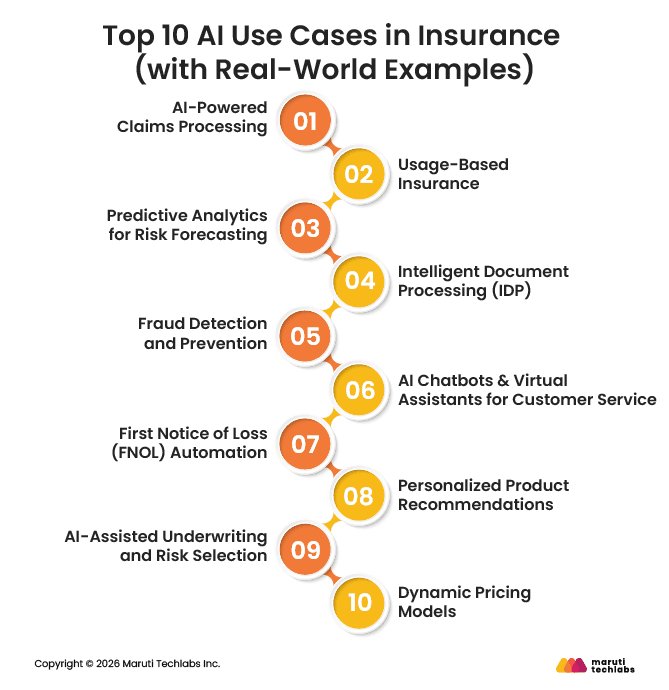
Top 10 AI Use Cases in Insurance (with Real-World Examples)
Challenges & Risks of AI in Insurance
Future of AI in Insurance
Conclusion
Why Maruti Techlabs
FAQs
Key Takeaways
AI is no longer experimental in insurance. It is already driving real outcomes across core operations.
Generative AI is shifting insurers from analysis to action with faster content, decisions, and responses.
Claims, underwriting, and fraud detection are seeing the fastest AI-driven transformation.
Real-time data and AI models are making pricing, risk assessment, and decisions more dynamic.
Automation across FNOL, documents, and support is cutting manual effort and turnaround time.
Scaling AI is not just about tools. Data quality, compliance, and system integration decide success.
The next phase of insurance will be defined by speed, personalization, and AI-led decision making.
Introduction
Artificial intelligence is changing how insurance companies process claims, detect fraud, and evaluate risk. Fortune Business Insights reports that the global AI in insurance market surpassed $10 billion in 2025 and is expected to exceed $13 billion in 2026.
Many insurance companies have already started adopting AI. In fact, nearly 90% of insurers have started exploring and evaluating Gen AI across operations.
To scale these efforts effectively, many are investing in AI strategy & readiness services to identify the right use cases and build a clear adoption roadmap.
As competition increases and customer expectations continue to rise, AI is helping insurers work faster, reduce costs, and offer more personalized services.
So, where is AI making the biggest difference today? Let’s look at the most impactful use cases in insurance.
What is AI in Insurance
AI in insurance refers to the use of technologies such as machine learning, natural language processing, and computer vision to analyze data, automate decisions, and improve operations across the insurance value chain.
By integrating AI into core functions like underwriting, claims processing, and customer service, insurers can reduce manual effort and streamline workflows.
AI systems can extract insights from documents, assess risk profiles, and even interact with customers through virtual assistants, improving both efficiency and responsiveness.
Overall, AI is transforming insurance from a reactive, process-heavy industry into a more predictive, data-driven ecosystem focused on speed, accuracy, and personalized customer experiences.
Top 10 AI Use Cases in Insurance (with Real-World Examples)
AI is actively transforming core insurance functions, from claims processing to risk assessment and customer engagement. Insurers are using it to improve efficiency, reduce costs, and deliver better experiences.
Here are the most impactful AI use cases in insurance with real-world examples.
1. AI-Powered Claims Processing
AI evaluates incoming claims by scanning submitted images, text, and metadata to determine eligibility and automate payouts. Smart algorithms can apply anti‑fraud checks and either approve simple claims instantly or escalate complex cases to human adjusters.
Business Impact
Claims are processed far faster than traditional manual review, reducing settlement time and operational costs while boosting customer satisfaction.
Real-World Example
Digital insurer Lemonade’s AI claims bot, Jim, can process claims in as little as 3 seconds for straightforward cases, with the system resolving more than half of such claims automatically.
2. Usage‑Based Insurance
AI and telematics data (from sensors or mobile apps) continuously monitor real-world driving behavior, such as acceleration, braking, mileage, and time on the road, to calculate customized risk profiles. This data feeds models that adjust premiums based on how individuals actually drive.
Business Impact
Insurers reward safer drivers with lower rates, improve risk accuracy, and encourage better driving habits.
Real‑World Example
Progressive’s Snapshot program personalizes auto insurance rates based on real driving behaviour. It adjusts premiums over time and rewards safer drivers as more data is collected.
3. Predictive Analytics for Risk Forecasting
Advanced AI models combine historical claims data, external risk factors (like weather or geology), and machine learning to forecast future risk exposures, rather than simply reacting to past losses.
Business Impact
Predictive risk forecasting helps insurers assess risk more accurately, set better prices, and take early action to reduce potential losses.
Real‑World Example
Zurich Insurance has implemented predictive analytics models to assess risk in life insurance applications, particularly for customers with mental health disclosures. By analyzing historical data, medical patterns, and lifestyle indicators, its AI models can predict risk and support faster underwriting decisions.
4. Intelligent Document Processing (IDP)
AI with OCR and NLP automatically reads and digitizes unstructured documents (e.g., PDFs, handwritten forms), extracts relevant data, and integrates it into workflows without human transcription.
Business Impact
Reduces manual data entry, shortens processing times, and eliminates human error in document‑intensive tasks such as claims intake or policy changes.
Real‑World Example
AXA XL uses AI to automate the extraction and analysis of property risk engineering reports, accelerating data capture for underwriting and risk evaluation.
5. Fraud Detection and Prevention
Machine learning models comb through large volumes of claims data and behavioural patterns to detect anomalies and potential fraud that traditional rules‑based systems miss.
Business Impact
Early detection prevents payouts on suspicious claims, reducing financial leakage and lowering investigation workloads.
Real‑World Example
Allianz uses Clearspeed AI’s voice analytics to detect fraud, flagging suspicious claims early and speeding up processing for genuine customers. This has helped reduce fraudulent payouts by 29% while improving claims handling efficiency for legitimate claims.
6. AI Chatbots & Virtual Assistants for Customer Service
AI chatbots and virtual assistants use natural language processing (NLP) to understand and respond to customer queries in real time. They can handle tasks such as policy inquiries, claim status updates, and basic troubleshooting without human intervention.
These systems go beyond scripted responses by learning from interactions, enabling more accurate and context-aware conversations over time.
Business Impact
Reduces response times, lowers call center workload, and ensures 24/7 availability. It also improves service consistency while allowing human agents to focus on more complex or high-value interactions.
Real-World Example
In an interview with The New York Times, MetLife executives shared that their AI-powered customer support solution delivered measurable improvements across key service metrics. The implementation led to a 3.5% increase in first-call resolution, a 13% rise in customer satisfaction, and a 50% reduction in average call time.
7. First Notice of Loss (FNOL) Automation
With AI‑driven FNOL systems, customers can submit loss information through mobile apps or web forms, which AI then processes automatically, extracting relevant data and triggering workflows.
Business Impact
Faster FNOL initiation, reduced call center load, and a smoother claims experience with quicker response times for policyholders.
Real‑World Example
American insurance company Allstate uses AI to streamline the FNOL process by capturing and processing incident data in near real time. Through its AI-powered systems, accident data is analyzed instantly and, when certain conditions are met, a claim is automatically initiated.
8. Personalized Product Recommendations
AI uses customer behaviour, demographics, and interaction history to recommend insurance coverage options tailored to individual needs rather than generic offerings.
Business Impact
Personalization increases policy conversion, cross‑sell uplift, and customer satisfaction by suggesting relevant products at the right time.
Real‑World Example
While speaking to Business Insider, Aleksandar Vidović, CEO of Zurich’s AI division (ZCAM), shared how the company’s AI-powered CRM system helps agents deliver personalized product recommendations and next-best actions.
9. AI-Assisted Underwriting and Risk Selection
AI analyzes large volumes of structured and unstructured data, such as medical records, financial histories, and behavioral patterns, to assess risk more accurately. It helps underwriters make faster, data-driven decisions by identifying patterns that are difficult to detect manually.
Business Impact
AI reduces underwriting time, improves risk accuracy, and minimizes manual effort. It also enables insurers to process more applications efficiently while maintaining consistency in decision-making.
Real-World Example
Prudential uses AI-powered underwriting tools to evaluate life insurance applications by analyzing medical data, prescription histories, and lifestyle information.
Its automated underwriting system, Fast Track, enables eligible applicants to receive decisions in minutes rather than days, improving the customer experience while maintaining accurate risk assessment.
10. Dynamic Pricing Models
AI enables real‑time or near‑real‑time adjustments to premiums based on evolving risk signals (behavioural data, environmental patterns, claims experience), rather than static historical rating tables.
Business Impact
Dynamic pricing aligns premiums with up‑to‑date risk profiles, leading to fairer pricing and improved competitive positioning.
Real‑World Example
Progressive’s telematics‑based UBI pricing continuously adjusts rates based on actual driving behaviour through Snapshot.
Challenges & Risks of AI in Insurance
AI in insurance presents complex challenges that insurers must address carefully. From regulatory pressures to technical limitations, these risks can impact trust, compliance, and long-term ROI if not managed effectively.
A clear understanding of these challenges is essential to ensure responsible and sustainable AI implementation.
1. Data Privacy & Regulation
Insurance companies handle highly sensitive customer data, making privacy and compliance non-negotiable. Regulations such as GDPR and evolving regional laws require secure data management, explicit consent, and full transparency in data usage.
Any lapse can result in significant financial penalties, reputational damage, and loss of customer trust.
2. Ethical Use of Generative AI
The use of generative AI raises ethical concerns, particularly in areas such as policy communication, automated decision-making, and synthetic content generation. These concerns are becoming more prominent as gen AI use cases in insurance gain traction.
Insurers need to ensure transparency, explainability, and human oversight to avoid misuse and maintain accountability while aligning with industry standards.
3. Model Bias
AI models trained on incomplete or biased datasets can lead to unfair outcomes in underwriting and claims processing.
Such biases not only create compliance risks but also damage credibility and customer confidence. Ongoing monitoring and the use of diverse, high-quality data are critical to reducing bias.
4. Security Concerns
AI systems and data pipelines are increasingly becoming targets for cyber threats, including data breaches and adversarial attacks.
These risks can compromise sensitive information and disrupt business operations. Strong security frameworks and continuous monitoring are essential to safeguard AI systems.
5. Integration & Legacy Systems
Many insurers still rely on legacy infrastructure, making AI integration complex and resource-intensive. Data silos, compatibility issues, and outdated systems can slow down implementation.
Without proper modernization and strategic planning, organizations may struggle to realize the full value of AI while facing increased costs and inefficiencies.
Future of AI in Insurance
The insurance industry is entering a phase where AI and generative AI are no longer optional. They are becoming central to how insurers assess risk, serve customers, and run operations.
Over the next three to five years, AI will move deeper into everyday workflows. Predictive models will help insurers anticipate risks before they occur, claims processing will approach real-time, and personalization will go far beyond basic segmentation. AI will not just support decisions, it will start shaping them.
Generative AI will play a key role in this shift. It will help insurers create personalized policy documents, generate detailed claims summaries, and simulate various risk scenarios to improve underwriting. As gen AI use cases in insurance continue to evolve, they will enable faster product innovation and more tailored offerings.
Conclusion
AI is no longer a future concept in insurance. It is already reshaping how insurers operate, from faster claims processing to smarter risk assessment and highly personalized offerings.
As competition grows and customer expectations rise, insurers that adopt AI strategically will be better positioned to improve efficiency, reduce costs, and deliver superior customer experiences. The focus now is not just on adopting AI, but on scaling it effectively across the organization.
Why Maruti Techlabs
At Maruti Techlabs, we help insurers turn AI from a concept into a real business impact. With deep expertise in building and scaling AI solutions, we enable organizations to improve efficiency, enhance customer experiences, and drive smarter decision-making across operations.
In a recent project, we helped a leading U.S.-based insurance broker streamline underwriting with an OCR-powered AI solution. It automatically extracted and validated data from FNOLs and financial documents, reducing manual effort and errors.
The result was a 40% reduction in underwriting processing time, enabling faster, more efficient decision-making.
Explore our Generative AI Services to streamline workflows, automate content, and unlock new opportunities across underwriting, claims, and customer engagement.
FAQs
1. How is generative AI used in insurance?
Generative AI automates policy drafting, generates claims reports, and personalizes customer communication. It also supports underwriting simulations, fraud detection, and chatbots, improving efficiency and customer experience.
2. Is generative AI the future of insurance?
Yes, generative AI is becoming central to the insurance industry. It enables personalized products, faster claims handling, and proactive risk management, making it a key driver of future growth.
Common gen AI use cases in insurance include underwriting simulations, fraud detection, and chatbots, all of which improve efficiency and customer experience.
3. How can insurers get started with AI adoption?
Insurers can begin AI adoption by identifying high-impact areas like claims processing, underwriting, and customer service. Starting with pilot projects, ensuring data quality, and integrating scalable AI platforms is key. Partnering with technology providers and fostering a culture of innovation will effectively accelerate enterprise-wide adoption.
4. How is generative AI different from traditional AI in insurance?
While traditional AI focuses on analyzing data and making predictions, generative AI can create new content, such as policy documents, claims summaries, and customer responses, enabling faster, more dynamic workflows.
5. How long does it take to implement AI in insurance?
The timeline depends on the use case and data readiness. Simple use cases like chatbots can be deployed quickly, while enterprise-wide AI transformations may take several months.
Pinakin Ariwala has over 20 years of experience in AI/ML, data engineering, and software development. He has led AI and machine learning projects across industries, including agriculture, finance, and healthcare, and has been featured on the Clutch Leaders Matrix podcast discussing real-world AI/ML applications.
Stuck with a Tech Hurdle?
We fix, build, and optimize. The first consultation is on us!